Of all the ways to make coffee at home, none is as forgiving on equipment and as unforgiving on technique as the french press. There’s no paper filter to blame, no gooseneck kettle to master, no pressure gauge to worry about. Just coarse grounds, hot water, and time. And yet plenty of people who own one still end up with a cup that’s bitter, muddy, or full of sediment — not because french press coffee is hard, but because a couple of small details get skipped every time.
Why French Press Tastes Different
A french press is a full-immersion brewer: the grounds sit directly in the water for the entire brew, rather than water passing through them once like it does in pour over or drip. Because there’s no paper filter, the coffee’s natural oils and fine particles stay in the cup instead of getting caught. That’s exactly why french press coffee has the heaviest body and fullest mouthfeel of any common brew method — it’s the closest home brewing gets to tasting the coffee’s oils as well as its flavour.
The trade-off is texture. Some sediment at the bottom of the cup is normal and expected, not a sign you did something wrong. If you want a completely clean cup, that’s what pour over coffee is for. If you want body and richness, french press is doing exactly what it’s supposed to.
The Equipment You Actually Need
This is the shortest equipment list in coffee brewing:
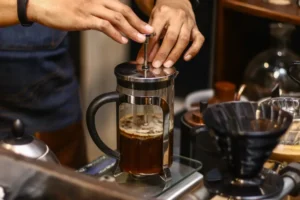
The press itself. Glass carafes let you see the brew, but are the most fragile. Stainless steel retains heat better and travels well. Either works fine — the mesh plunger filter is doing the real work either way.
A kettle. No gooseneck required here, since you’re not pouring in a slow, controlled stream the way pour over demands. Any kettle that gets water to temperature works.
A scale (optional but useful). Like pour over, french press is a ratio game. Eyeballing it is where a lot of home brews go wrong.
A timer. The one non-negotiable. Steep time is what separates a balanced cup from a bitter one.
Getting the Ratio and Grind Right
Start at a 1:15 ratio — one gram of coffee to fifteen grams of water — slightly stronger than pour over’s typical 1:16, since immersion brewing extracts a bit differently. So 30g of coffee to 450g (roughly 450ml) of water makes a solid full press. Adjust from there once you know your own preference — heavier on coffee for a bolder cup, lighter for something milder.
Grind size matters more here than almost any other method: it needs to be coarse, noticeably coarser than pour over, closer to sea salt than sand. This isn’t a style preference — it’s what keeps the mesh filter from letting fine grounds and sediment through into your cup. A grind that’s too fine is the single most common reason french press coffee turns out gritty or over-extracted.
The Step-by-Step Method
1. Boil water and let it rest for 30 seconds off the heat, aiming for roughly 92–96°C.
2. Add your coarsely ground coffee to the empty press.
3. Pour in all the water at once, saturating the grounds evenly. Give it a gentle stir to make sure no dry clumps are floating on top.
4. Place the lid on with the plunger pulled all the way up — don’t press yet. This traps heat and keeps the brew steady.
5. Steep for 4 minutes. This is the number to defend. Less than 4 minutes and you’re under-extracted and thin; much past 5 and it tips toward bitter.
6. Press down slowly and steadily. If you feel heavy resistance, your grind is too fine — note it for next time.
7. Pour immediately. Leaving coffee sitting on the grounds after pressing keeps extracting it, even after the plunge. If you’re not drinking it all at once, pour the rest into a separate carafe.
Common Mistakes Worth Fixing
Grinding too fine. This is responsible for most bad french press coffee — bitterness, sludge in the cup, and a plunger that’s hard to press. If in doubt, go coarser.
Steeping too long. Walking away and forgetting about it for 8–10 minutes is the second most common mistake. Set a timer, every time.
Leaving coffee in the press after brewing. Even after you’ve plunged, the grounds are still touching the coffee until you pour it out. Decant what you’re not drinking immediately.
Using stale beans. Full immersion brewing exposes flat, stale coffee fast — there’s nowhere for tired beans to hide when they’re steeping directly in the water for four minutes. Check the roast date, not just the best-before date.
Which PJC Roast Suits French Press Best
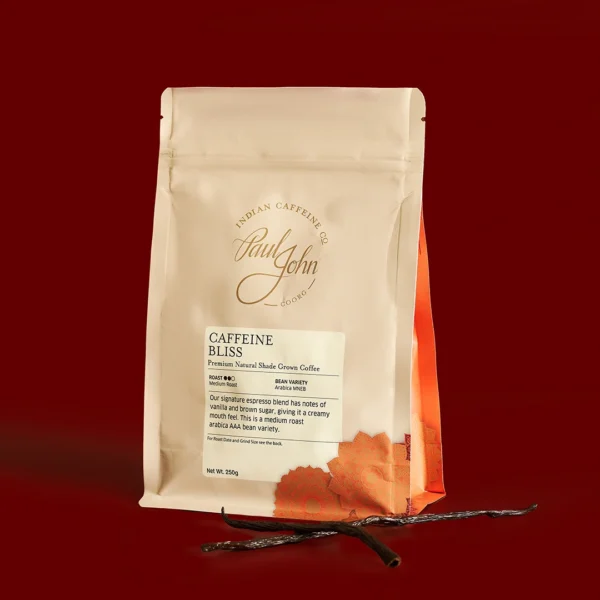
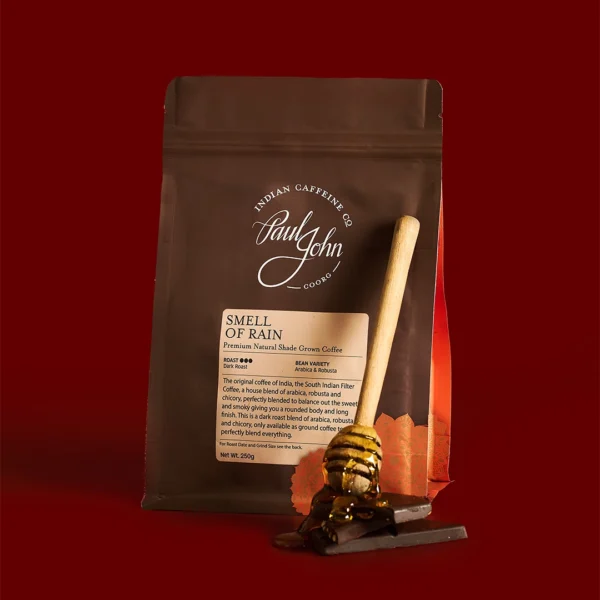
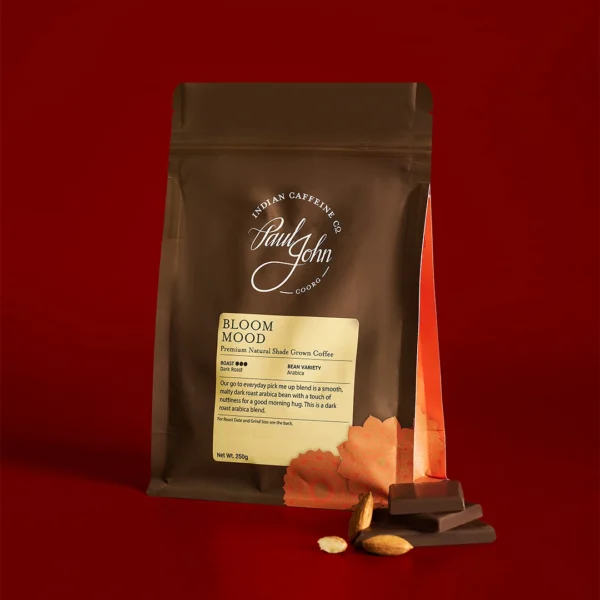
Because french press brings through body and oils that paper-filtered methods leave behind, it pairs especially well with roasts that already lean toward depth rather than delicate brightness. PJC Medium Roast is the natural fit — its caramel and chocolate notes come through fully in a method built to carry weight, without tipping into the heaviness that can make a lighter roast taste unbalanced in full immersion. PJC Dark Roast works well too if you want maximum body and don’t mind the more intense, smoky profile coming through at full strength. If you’re chasing the bright, floral character of Light Roast specifically, that’s better served by pour over coffee, where the paper filter and lighter body let those notes stand out instead of getting rounded off.
Either way, it’s still 100% arabica coffee beans doing the work — french press just asks a bit more of the bean, since nothing is filtered out to hide behind.
Bring It Home
French press asks less of your equipment budget and more of your attention to two numbers: grind size and steep time. Get those right and you’ll have one of the richest, most satisfying cups available at home, no filters or fancy gear required.
Ready to brew a fuller-bodied cup? Buy coffee online from Paul John Caffeine and pick up a Medium or Dark Roast built to carry the weight french press brings out. Order coffee online today and taste what a properly pressed cup is supposed to feel like.